


“We are certified” is the least useful sentence in a fabrication quote.
Certified to what standard, for which welding process, in which position, on what material, up to what thickness, and valid until when? Without those six answers, the claim tells a facilities manager or trustee nothing at all.
This guide explains how welding certification actually works in South Africa, which standards apply here rather than in the United States, and the questions that separate a partner who can evidence quality from one who is hoping you will not ask.
Key takeaways
| What to check | Why it protects you |
|---|---|
| Welder qualification scope | Qualification is tied to process, position, material and thickness. One certificate does not cover every job. |
| Procedure qualification (WPS and WPQR) | A qualified welder following an unqualified procedure still produces unpredictable results. |
| Company-level certification | ISO 3834 covers the firm’s welding quality system, not one welder on one day. |
| Who issued it | In South Africa, SAIW Certification is accredited by SANAS and authorised by the IIW. |
| Validity dates | Welder qualifications expire. An out-of-date certificate is not a certificate. |
| Inspection and records | Checks before, during and after welding, documented in a form you can request later. |
Quick answers
What welding certification applies in South Africa?
Welder qualification here is most commonly tested to ISO 9606, which is widely used locally. Welding procedures are qualified to ISO 15614-1, adopted nationally as SANS 15614-1. Companies are certified to ISO 3834. ASME IX and AWS D1.1 also appear on South African projects, particularly in petrochemical, power and pressure work.
Who issues welding certification in South Africa?
The Southern African Institute of Welding, through SAIW Certification. It has been an IIW Authorised National Body since 2003 and an Authorised National Body for Company Certification since 2008, and it is accredited to ISO 17024 by SANAS.
What is the single most useful question to ask a fabrication partner?
“Can I see the welder qualification record and the WPS that covers this specific joint?” A partner with a quality system answers in minutes. One without will change the subject.
Why a welding certification claim is not an answer on its own
Welding certification is narrow by design. A welder qualified for MIG on 6mm mild steel in the flat position is not automatically qualified for TIG on stainless in the overhead position. Change the process, the position, the material group or the thickness range and you may be outside the qualified scope.
That is not bureaucracy. It exists because each of those variables changes how the metal behaves, and the test proves competence under the specific combination it covers.
So when a quote says “our welders are certified”, the useful follow-up is simple: certified for what? If the answer to that is vague on a handrail, it is a nuisance. On a structural support frame or a platform carrying people, it is a liability.
The three layers of welding certification buyers should separate
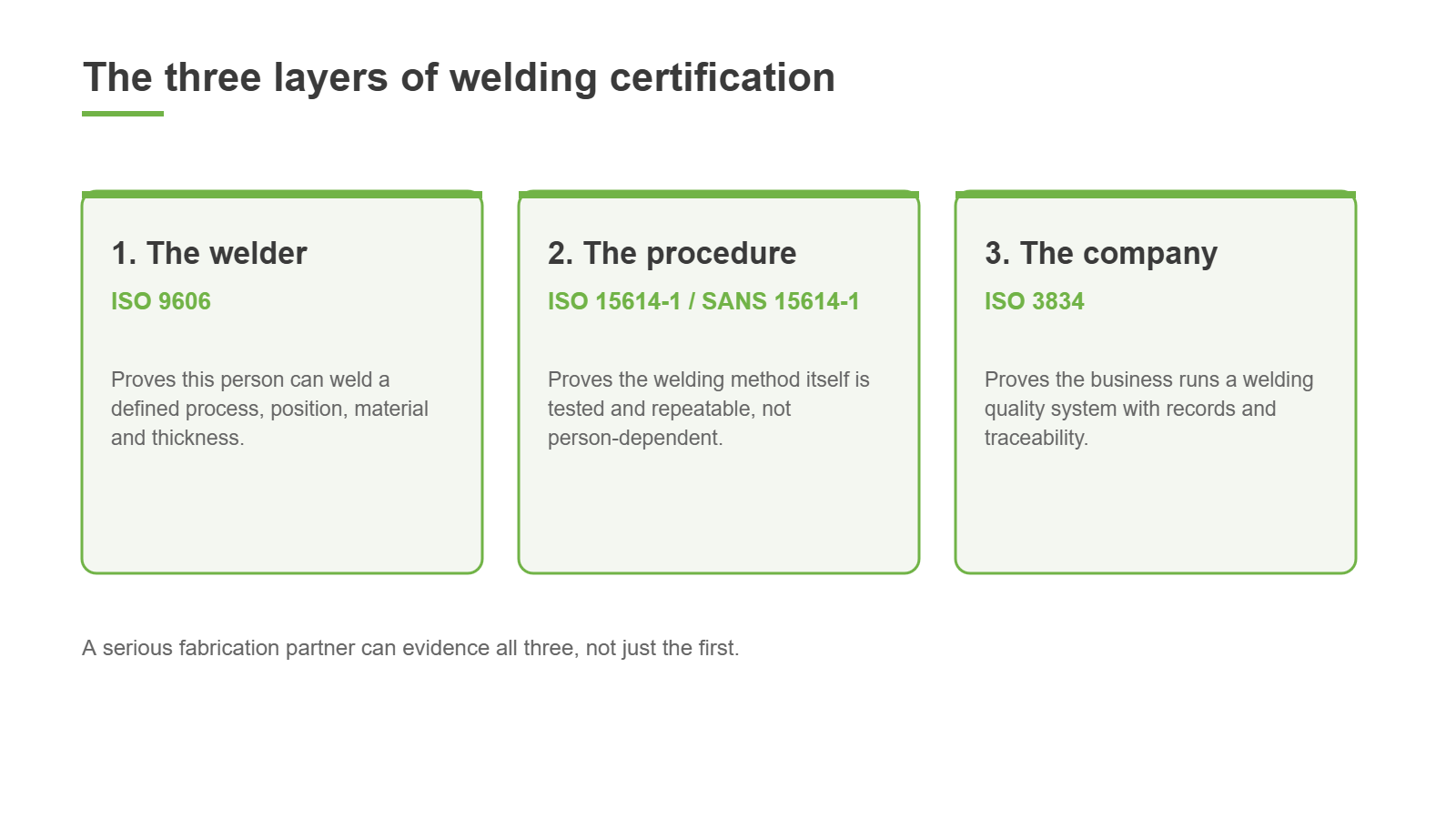
Most welding certification confusion comes from treating three different things as one. They are not interchangeable, and a serious partner will have all three.
| Layer | Standard | What it proves |
|---|---|---|
| 1. The welder | ISO 9606 (also ASME IX or AWS D1.1 on some projects) | This person can produce an acceptable weld in a defined process, position, material and thickness range. |
| 2. The procedure | ISO 15614-1, adopted as SANS 15614-1 | The welding method itself has been tested and recorded, so the result is repeatable rather than dependent on the individual. |
| 3. The company | ISO 3834 | The business runs a welding quality management system: records, review, competent coordination and traceability. |
Layer three is the one almost nobody asks about, and it is the most telling. ISO 3834 sets quality requirements for fusion welding of metallic materials, and in South Africa it is operated through the SAIW Welding Fabricator Certification Scheme. SAIW was the first organisation outside Europe authorised by the IIW to run the manufacturer certification scheme, and it also offers a second scheme built on the quality control requirements of ASME Section VIII Division 1 Appendix 10.
A firm certified at company level has already been audited on the things you would otherwise have to check yourself.
One note on the ISO 15614-1 levels, since “levels” causes confusion
People often ask about welding certification “levels” as though there is a single ladder from beginner to expert. There is not, but there is one place the word has a precise meaning worth knowing.
ISO 15614-1 sets out two levels of welding procedure test. Level 1 is based on the requirements of Section IX of the ASME Boiler and Pressure Vessel Code. Level 2 is based on the previous issues of ISO 15614-1 and is generally the more demanding of the two. If a partner references a procedure qualification, asking which level it was qualified to is a fair and revealing question.
Separately, the IIW does operate a genuine hierarchy of personnel qualifications: Engineer, Technologist, Specialist, Practitioner, Welder and Inspector. SAIW offers the full range of these in South Africa. On a project of any complexity, the relevant question is not only whether the welders are qualified but whether anyone coordinating the work holds a qualification above welder level.
Where AWS and American credentials actually fit
Plenty of welding content aimed at South African readers is quietly written for an American audience, citing AWS certification, CWI inspectors and dollar exam fees. That is worth naming, because it leads buyers to ask for the wrong evidence.
The honest position: AWS D1.1 and ASME IX are relevant in South Africa, and SAIW itself notes that ISO 9606 is similar in purpose to both. They appear regularly in petrochemical, power generation and pressure work, often because a client specification or an international EPC contract calls for them.
What they are not is the default. For general structural steel, plate work and estate infrastructure in Gauteng, ISO 9606 and ISO 3834 through SAIW are the ordinary reference points. If a supplier leads with AWS credentials on a handrail or platform job, it is worth asking why, and whether the qualification scope actually covers your joint.
Pressure equipment is a separate legal question
If your scope touches pressurised systems, this stops being a procurement preference and becomes a regulatory matter.
Inspection personnel with statutory responsibilities under the Pressure Equipment Regulations are certified through SAQCC programmes, administered by SAIW Certification and accredited to ISO 17024 by SANAS. Non-destructive testing personnel fall under the same certification structure.
For most estate and commercial property work this will not apply. When it does, a partner who cannot immediately tell you which statutory category applies is the wrong partner for that scope.
The inspection layer, which is where defects get caught
Welding certification proves capability. Inspection proves it happened on your job.
You do not necessarily need a named inspector role on a small scope, but you do need the behaviour. Four questions cover it:
- Who inspects? A defined role, or whoever is free that afternoon?
- What gets checked, and when? Fit-up and cleanliness before welding, adherence to the procedure during, acceptance after. Final visual inspection alone catches very little.
- How is acceptance recorded? You should be able to request a record months later and receive one.
- What happens on a nonconformance? Corrected and re-inspected, or quietly ground flat and painted over?
The last one is the tell. Every fabricator has nonconformances. The difference is whether they are recorded and fixed or hidden.
A welding certification checklist for your next quote
| Ask this | A good answer | A warning sign |
|---|---|---|
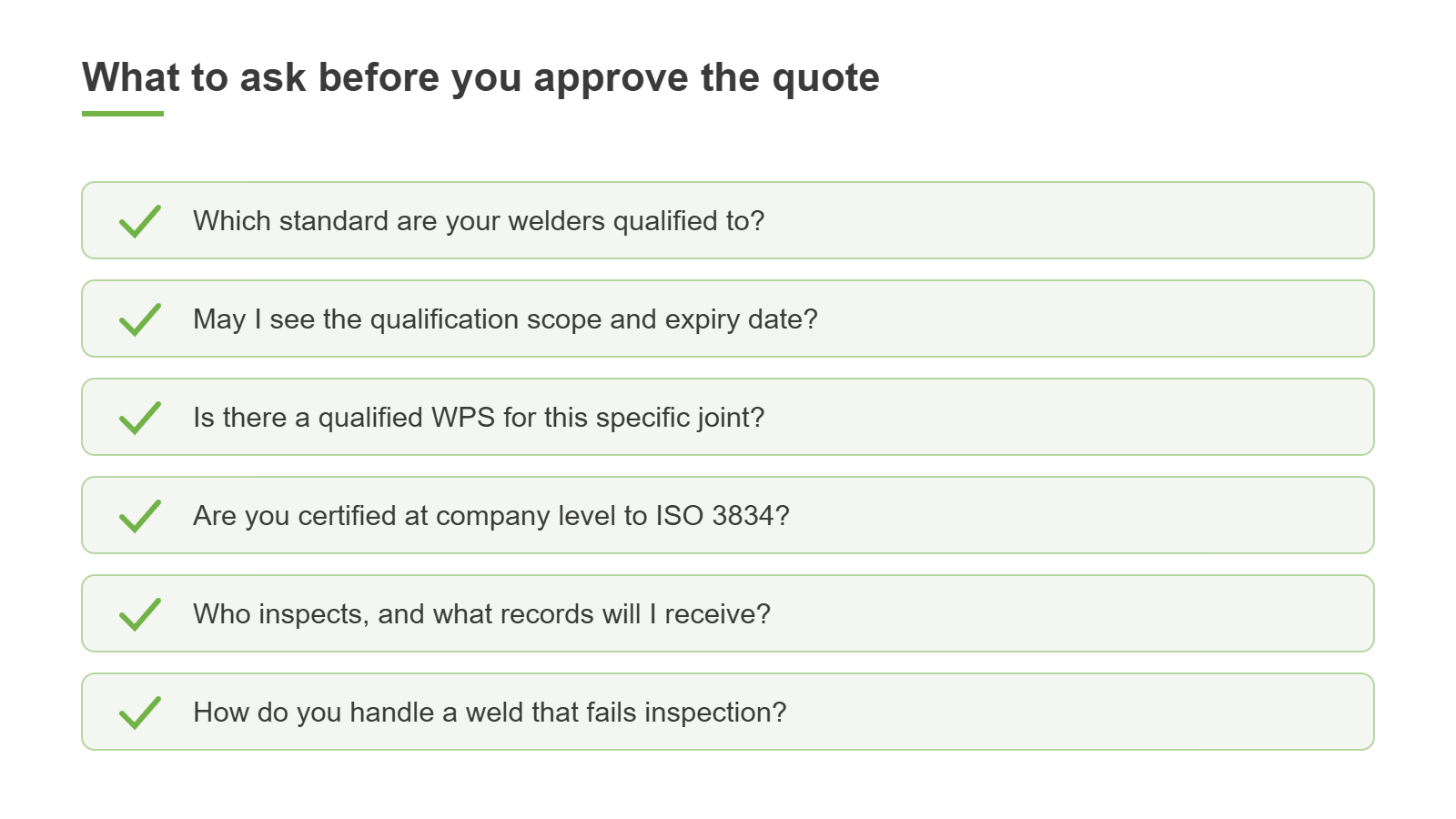
| “Which standard are your welders qualified to?” | A named standard and issuing body. | “All our guys are qualified.” |
| “May I see the qualification scope and expiry?” | Documents produced without fuss. | Delay, deflection, or a certificate with no dates. |
| “Is there a WPS for this joint?” | Yes, with a procedure qualification behind it. | “Our welders know what they are doing.” |
| “Are you certified at company level?” | A clear yes or a clear no, with reasons. | Confusing company certification with welder certificates. |
| “Who inspects, and what will I receive?” | A named role and a records handover. | Inspection described only as a final look. |
| “How do you handle a failed weld?” | Cut out, re-weld, re-inspect, record. | Anything that sounds like cosmetic repair. |
Four mistakes that cost money on Gauteng projects
- Treating one certificate as blanket cover. It is scope-specific. Always.
- Checking the welder but not the procedure. A qualified welder working without a qualified procedure gives you a competent person guessing consistently.
- Skipping preparation and expecting the weld to carry it. Poor fit-up, contamination and wrong surface condition cause far more failures than technique does. Where steelwork ties into concrete or drainage, preparation is a shared responsibility across trades, which is why civil and concrete work and steel fabrication should not be procured as if they never touch.
- Letting reactive work become the operating model. Emergency repairs compress every quality step at once. A planned maintenance structure is what keeps welding decisions from being made under time pressure.
What this looks like in practice
On structural steel and plate work, the controls that matter are unglamorous: measure on site, fabricate to tolerance in the shop, and install so components fit first time rather than being forced into position. Forced fit is where quality quietly leaves a project, because the strain it introduces is invisible until something moves.
If your scope covers support frameworks, platforms, staircases, handrails, gates or palisade steel, our structural steel, plate work and fabrication service sets out how that sequence is delivered. For estates and body corporates wanting the planned structure that keeps reactive repairs rare, see estate maintenance.
Frequently asked questions
What welding certification should a fabrication partner hold in South Africa?
Welder qualification to ISO 9606 covering your specific process, position, material and thickness, a qualified welding procedure under ISO 15614-1 or SANS 15614-1, and ideally ISO 3834 certification at company level. On petrochemical, power or pressure scopes, ASME IX or AWS D1.1 may be specified instead.
Who issues welding certification in South Africa?
SAIW Certification, the certification division of the Southern African Institute of Welding. It is an IIW Authorised National Body, an Authorised National Body for Company Certification, and accredited to ISO 17024 by SANAS. It publishes a national register of qualified individuals and certified companies.
Is an AWS certification valid in South Africa?
AWS D1.1 is used on South African projects, particularly where a client specification or international contract requires it, and SAIW notes it serves a similar purpose to ISO 9606. It is not the default reference for general structural and estate steelwork here, so check that the qualification scope matches your actual joint rather than accepting the brand name.
Do welding qualifications expire?
Yes. Welder qualifications carry validity periods and conditions for remaining current. Always check the expiry date alongside the scope, because an expired certificate offers you no protection.
What is the difference between ISO 9606 and ISO 3834?
ISO 9606 qualifies an individual welder for a defined range of work. ISO 3834 certifies a company’s welding quality management system. One tells you a person can weld. The other tells you the business is set up to control quality across every job, which is the more useful signal when you are appointing a contractor.
Do I need a certified welding inspector on my project?
Not always, but you do need inspection to happen and to be recorded. On higher-risk scopes, or anything involving pressure equipment, statutory inspection requirements apply and are certified through SAQCC programmes under the Pressure Equipment Regulations.
How do I verify a certification claim?
Ask for the certificate, check the scope and expiry against your drawings, confirm the issuing body, and cross-check against SAIW’s published register where applicable. A partner with genuine certification will not object to any of that.
Before you approve the quote
Welding certification is not paperwork for its own sake. It is the difference between a supplier who can show you why the weld will hold and one who is asking you to take it on faith.
If you have steelwork coming up on an estate, a commercial property or an industrial site in Gauteng, get in touch and we will walk the scope with you, set out what qualification coverage the work actually requires, and quote against it.
